My name is Andrew Wee. I'm 32 years old, live in Singapore and am happily married with a 2 month old daughter.
I've gone through a list of various occupations including:
* journalist (for a business newspaper)
* Internet content developer (for one of Asia's largest media group's Singapore Press Holdings)
* trainer in entrepreneurship, business building, life skills
* photographer/photojournalist
* real estate agent
* consultant
* entrepreneur
(I think that's enough for now...more later!)
This is a personal space to express my goals, dreams and aspirations.
It’s a covert message and if you didn’t know that DreamWorks Animation’s recent hit Kung Fu Panda which raked in more than $60 million in the box office, pushing out Adam Sandler vehicle You Don’t Miss with the Zohan, also contains the internet marketing million dollar formula, you should rush out and watch it now.
Protagonist Po the Panda sets out to follow his passion for Kung Fu and inadvertently is chosen by the master tortoise Oogway to become the Dragon Warrior and master the secrets of the Dragon Scroll to become the ultimate KungFu master.
The analogy is that new internet marketers also set out to become masters themselves and are looking for their own “Dragon Scroll” to become the ultimate (fill in your preferred internet marketing specialty – affiliate marketing, search engine optimization, pay per click marketing, etc).
The same secret contained in the Dragon Scroll applies Continue reading →
The Twitter team has been working overtime with fixes intended to resolve the growing pains associated with the microblogging service, with regular updates at the Twitter blog and the Twitter status blog.
I am a little surprised and disappointed that several core Twitter features have been disabled in the interim.
The loss of private messaging I can live without (for the short term), but what happens when you are handicapped in your ability to follow conversations?
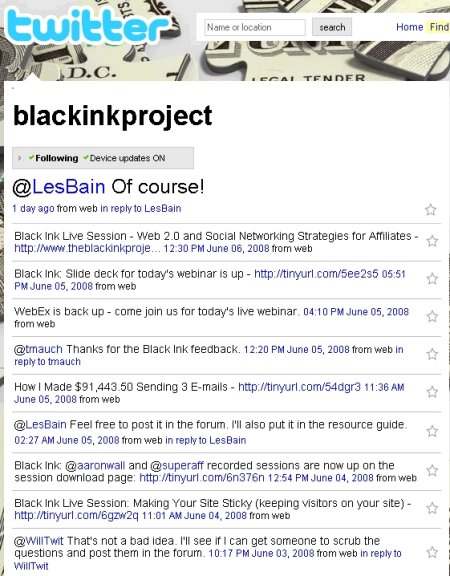
Witness the page for Jeremy Palmer’s Black Ink Project:
The pages show the twits originating from Jeremy, but the “With others” tab which you could click on and see the 2-way conversation is now missing.
If you want to track the conversation, you’d have to hit the “in reply to” hyperlink.
[At least that’s how I remember how I used to track conversations…]
So if you’d like to follow an active Twitter user, you’d be hitting the “in reply to” link pretty often and opening up a bunch of windows and study the timestamps and figure out the chronological sequences.
I may be wrong, but I thought the purpose of these technologies was to make things easier, rather than give me some weird sudoku-like puzzle to figure out what goes where?
–
Having installed the latest version of the Flock social web browser (based on the Mozilla code, which Firefox is based from), I noticed that there’s an integrated Twitter module.
I had a great time presenting a session on social marketing and web 2.0 technologies for Jeremy Palmer’s Black Ink Project today and it fired off a couple of thoughts on how Internet marketers can leverage their brand to enhance their business.
Especially if you’ve been traditionally focusing on PPC or Search Engine Optimization to generate leads and sales, these strategies can give you a couple more tools for your arsenal.
Social marketing is all about open communication and visibility. (transparency and honesty are key too).
If you don’t already have an online presence, look at how you want to position yourself.
At the heart of it, a Dell computer, an Apple iPod or an Asus Eee PC is just a bunch of circuit boards and electronic chips soldered together and encased in an aluminum or polycarbonate case. It’s marketing magic that imbues these objects with the emotional associations of style, ease-of-use, prestige, etc.
In his book, “All Marketers are Liars”, Seth Godin mentions how consumers are actually the ones lying to themselves. They imbue products and services with these larger-than-life characteristics and spending their income on “driving machines” and believe that a computer can help them “think different”.
If you’re an online marketer and you aren’t already picking up these tips to up your game, you could be missing out on the massive leverage these strategies provide.
Pickup artists like Neil Strauss AKA Style, Erik Von Markovik AKA Mystery talk about creating personas or social avatars. I don’t see this as very different from a brand that a company creates.
One question might be asked “So, how do I create my identity if I’m new to this?”
Answer: Create your identity based on what you want to be (your outcome) and strive towards it. An avatar is your desired outcome, you build it as a goal you want to achieve.
Having it consistent with your personal thoughts, values and attitudes will help you market via social media and web 2.0 with authenticity and brutal effectiveness. Projecting a picture of yourself as something you’re not is going to be a fruitless exercise down the road.
The pickup artists have put a practical application to Robert Cialdini’s concept of social proof – the idea of DHV’s or Demonstration of Higher Value. In Internet marketer speak, that’s becoming an authority site in your niche. (ok, I’m extending the concept further from its original position).
More importantly, social marketing still represents a pool of huge untapped potential – something like the Excalibur buried in a block of stone. The secret here is that anyone can be the “King Arthur” that pulls it out and unleashes its potential – it’s a matter of stepping up and taking action.
This clip with one of Mystery’s lieutenants, JDog, address the issue of creating avatars. Read between the lines and the same principles of focus, rather than “peacocking” will equally apply in your business too.
Market Leverage ranks as one of the networks which effectively uses its marketing and branding budget to devastating effect. By contrast, I work with several networks with great affiliates managers, and one corp comm/PR person who isn’t really empowered to do much and/or doesn’t have any real budget to work with.
As networks see affiliate acquisition as part of the affiliate management success formula, doubtless there’ll be more resources channeled towards building a quality affiliate base.
I appreciated Market Leverage’s Digital Media Relations specialist Debby Phillips arranging a discussion with Market Leverage’s founder and CEO Mike Jenkins.
Mike’s certainly savvier than the average network owner (who’s typically a successful affiliate marketer turned network owner). Conducting some research, I’ve found that Mike has been involved in the business management aspects for a number of pretty large listed firms too.
I especially like how he’s constructed a holistic business ecosystem under his PrecisionPlayMedia group – with 3 components – DigitalLeads (an in-house offer production/packaging subsidiary), Market Leverage (the CPA network arm) and InboxBeyond (an email publishing arm) – which is how the top tier CPA networks structure their business.
During the discussion, we also touched on, but haven’t fully resolved the issue of whether the community-building /relationship-building approaches of social marketing via blogs,video will eventually clash head-on with the current incarnation of affiliate marketing, with the mostly shorter emphasis on one-off lead acquisition payout.
It’ll also be interesting to track Market Leverage’s upcoming announcements in the next 2-3 months.
I just had a great discussion with Market Leverage founder and CEO Mike Jenkins about developments in the affiliate marketing industry.
Market Leverage is taking the lead when it comes to relationship building and branding with measures like it’s care package campaign to the top affiliate bloggers, and initiatives like Market Leverage TV. Kudos to Mike and his team for getting on the radar with innovative social marketing strategies.
In the course of our discussion, I was wondering — Will affiliate marketing come to blows with social marketing and social media?
From my discussion with affiliate managers, it seems that the majority of affiliate marketers are only interested in the one-time pay-per-lead or pay-per-sale commission structures. Ask them about revenue share or continuity (eg: subscription/membership) type payouts and they aren’t as keen.
With some bizop offers paying out $100-120 per lead or sale, this could trigger the “quick cash” impulse among some affiliates.
On the other hand, savvy merchants and advertisers would’ve grasped the subtleties of lead generation, building up an leads database and reselling the data or marketing offers to that database, and in many scenarios employing both techniques.
In this case, rev share, especially for a CPA-based network will be a moot point.
This is the business model for “affiliate marketing 1.0” if you want to apply a label to it.
–
With social marketing and its technologies like video, social networking, blogging, forums, etc, the emphasis is on building the relationship, forming a community, focusing on the long-term – pretty much a complete opposite to “affiliate marketing 1.0”.
Sure you could just take the tech aspects of social media – the viral marketing, the video and audio which massively increase conversions and leave the relationship benefits at the door. But does that strip social marketing of some of its inherent benefits? Do merely become an updated version of “social engineering” as practised by Kevin Mitnick and others?
It’ll be interesting to see how these initiatives pan out.
Tune in to the Friday Podcast tomorrow to check out the interview with Market Leverage founder Mike Jenkins.
It’s a good thing that blogs and websites have the freedom to publish any information they like because readers has a smorgashboard of content to choose.
At the same time, if your content isn’t tightly planned out or executed (or just plain funny enough), you could find yourself creating a bunch of content that no one wants to read. I experienced this in my early days and it’s certainly not a fun experience.
If you’re planning to interview experts for a podcast, a product like a book or course, or to provide entertainment, here are a couple of tips to help you up your game:
Do your homework
Research your subject – their company AND their personal background. Having an insight into what the interviewee used to do and what they’re doing now can give you idea of how to structure the interview.
A good way to start is to google your interviewee’s name and company, or check Google News or Technorati or Techmeme.
Compiling the facts into a spreadsheet or text document and organizing it will help you with the next step:
Have a gameplan
While I enjoy the stream-of-consciousness element of some interviews, it can get old especially after a month or two of “more of the same”.
Like any written piece, an interview or discussion should have an introduction, a body where content is developed, and a conclusion.
If you incorporate “takeaways” into your session, or have tips or resources that listeners can immediately check out after the session, you’ll provide value, build content stickiness and form a core of loyal listeners/viewers.
Structuring the discussion by various interview topics will help create a more organized discussion, especially if you can spend time to address questions related to a specific topic before moving on.
Go with the flow and go deep
Although you have a gameplan in hand, use it as a rough guide. As interesting points develop, go deep on those topics – talking about case studies, specific examples, clarify definitions – to generate content depth.
As you talk about certain issues, parallel issues might also pop up, giving you an opportunity to “lateralize” your content. Heading in those directions, expands the scope of the discussion and provides an opportunity to create value.
Continually asking ‘what is the consequence of what the person just said, and how can I apply or use this information?” is a good metric to ensure that you remain on-topic.
–
For past sessions of the Friday Podcast, check out the podcast archive.



 Florida-based CPA network Market Leverage has generated a fair amount of buzz with it’s